16-Week Pilot Programme Leicester, East Midlands September 2026 – February 2027 Psychologically Planned Environment Brazilian Jiu-Jitsu Strength & Conditioning Therapeutic Group Work Years 8–9 at Risk of Exclusion HCPC Registered Clinical Lead Regulation · Reflection · Reintegration · Relationships ASDAN Accredited Lost in the System Hypothesis Trauma-Informed Practice Consent-Based No-Gi BJJ 16-Week Pilot Programme Leicester, East Midlands September 2026 – February 2027 Psychologically Planned Environment Brazilian Jiu-Jitsu Strength & Conditioning Therapeutic Group Work Years 8–9 at Risk of Exclusion HCPC Registered Clinical Lead Regulation · Reflection · Reintegration · Relationships ASDAN Accredited Lost in the System Hypothesis Trauma-Informed Practice Consent-Based No-Gi BJJ
Community Interest Company: Leicester, UK

A Psychological Intervention. Not a Sports Provision.

Every year, young people in our schools are failed; not because they are unteachable; but because the system misidentified what they actually needed. Urban Ronin CIC exists at that fracture point. A psychologically led intervention using strength and conditioning, psychological group work and BJJ. This is education done different.

13-year-olds = highest suspension rate
of any age group
CSJ Exclusion Tracker, Nov 2025, citing DfE Autumn 2024
90%
Of excluded pupils fail GCSE Maths & English
IPPR (2026), Who's Losing Learning
£170k
Lifetime cost to the state per excluded child
IPPR (2026), Who's Losing Learning
5.6×
More likely excluded if from a disadvantaged family
DfE, Suspensions and Permanent Exclusions in England: Autumn Term 2024/25
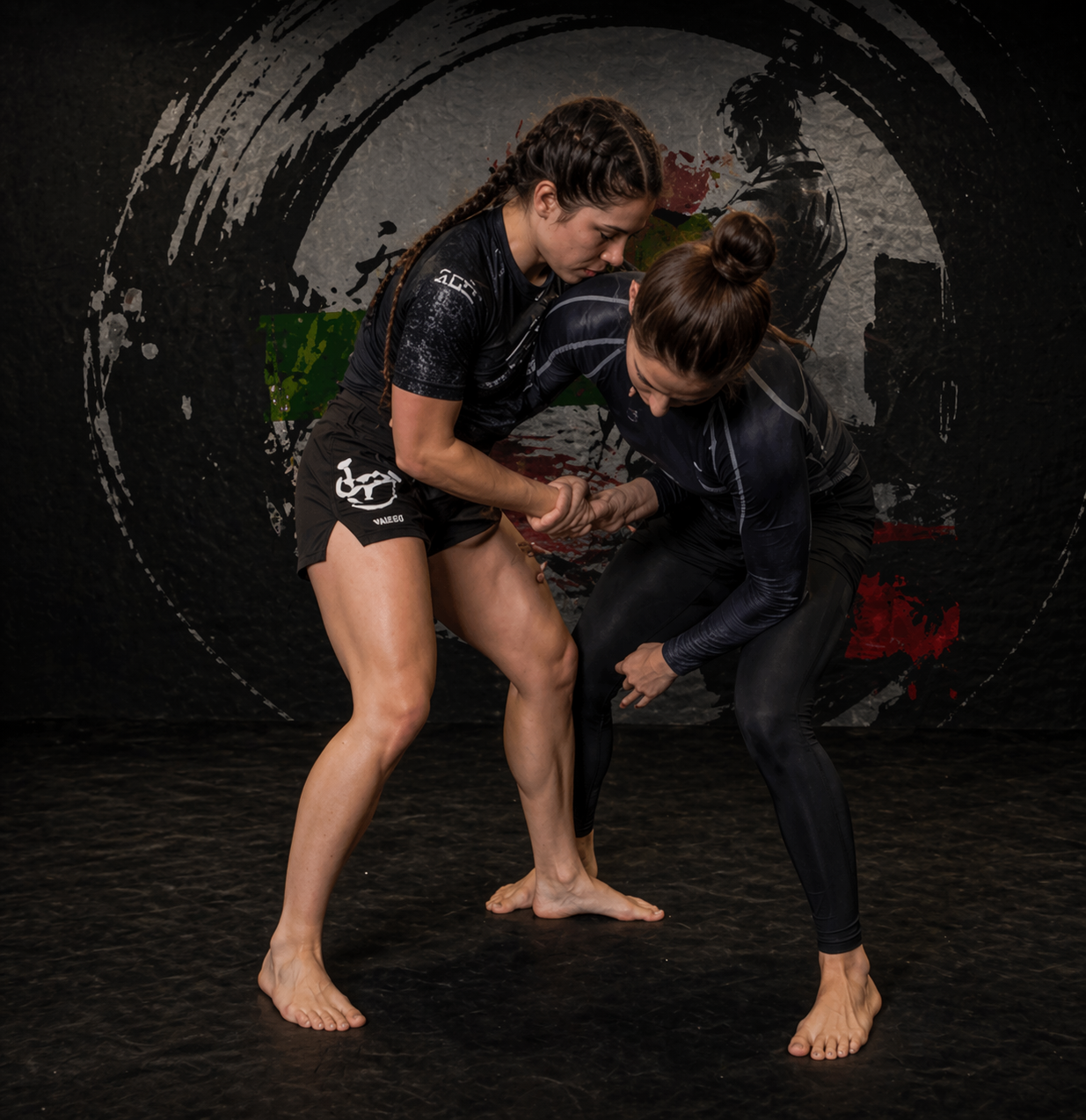
BJJ training: controlled takedown drill
The Problem We Solve

The Lost in the System
Hypothesis

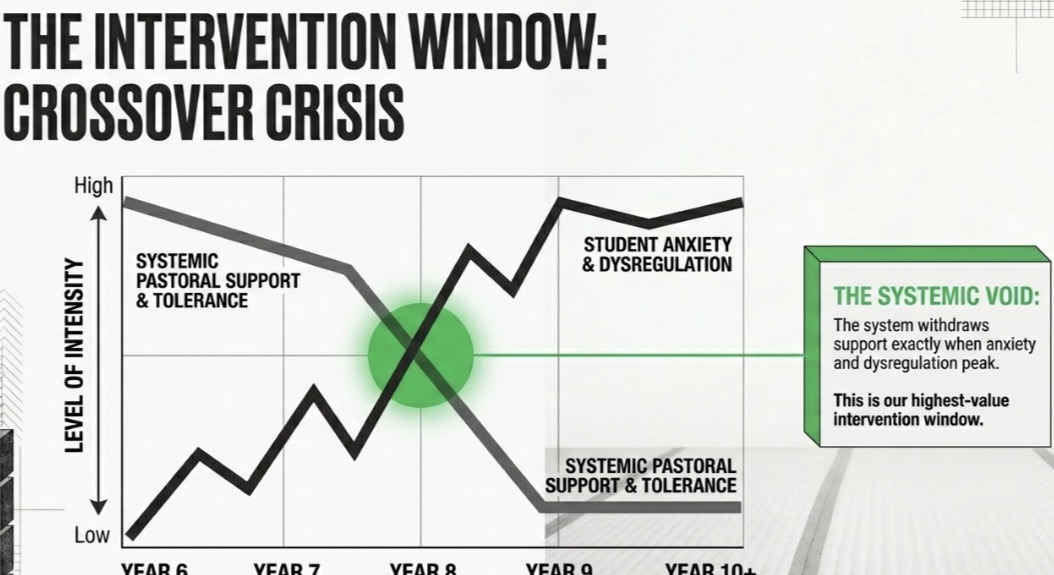
Most of the young people we work with were never invisible. They were known. In primary school, one teacher held them. That teacher knew their history, their triggers, their strengths. A small class. Familiar faces. A routine that made sense. It worked, just about.

Secondary school ends that.

Bigger site. Seven different teachers. A new cohort. Rising academic pressure. The one adult who knew them is gone. What was being quietly managed is now exposed, and the system that replaced it has neither the time nor the information to notice.

There is usually a brief period of tolerance in Year 7. Then expectations harden. Behaviour that was once understood becomes a problem to be managed. The young person gets labelled as disruptive when what they actually are is struggling.

By Year 8 the pattern accelerates. Fixed-term exclusions begin. Timetables shrink. Peers, curriculum, and the ordinary social development that school is supposed to provide all narrow at once. The young person starts to disappear from view while remaining nominally on roll.

The system does not intend this. But it withdraws support at exactly the moment anxiety and dysregulation peak. That gap is where the real damage happens. Exploitation risk rises. NEET trajectory begins. Without intervention, weeks become months, months become years.

The Intervention Window: Crossover Crisis

We work across the full arc of that journey.

Some of the young people we work with are still in school, just about. Escalating. At the edge. For them, early intervention can change the whole trajectory before permanent exclusion becomes inevitable.

Others are already out. Excluded, or effectively absent on a reduced timetable that keeps them on roll but delivers education in the same way that already stopped working for them. The model has not changed. Only the dose has reduced.

Others have been out for longer. The gap has grown. Trust in adults and institutions has eroded. For them, reintegration is a slower process, but it is not out of reach.

Wherever a young person sits on that journey, the approach is the same. We use sport not to keep young people busy but to get them into a state where learning, reflection and genuine change can happen. Every session is built around four mechanisms: Relationships, Regulation, Reflection, and Reintegration. Everything is deliberate. Nothing is filler.

We do not write young people off. We start where they are.
What We Deliver

Five Constructs.
One Clinical Framework.

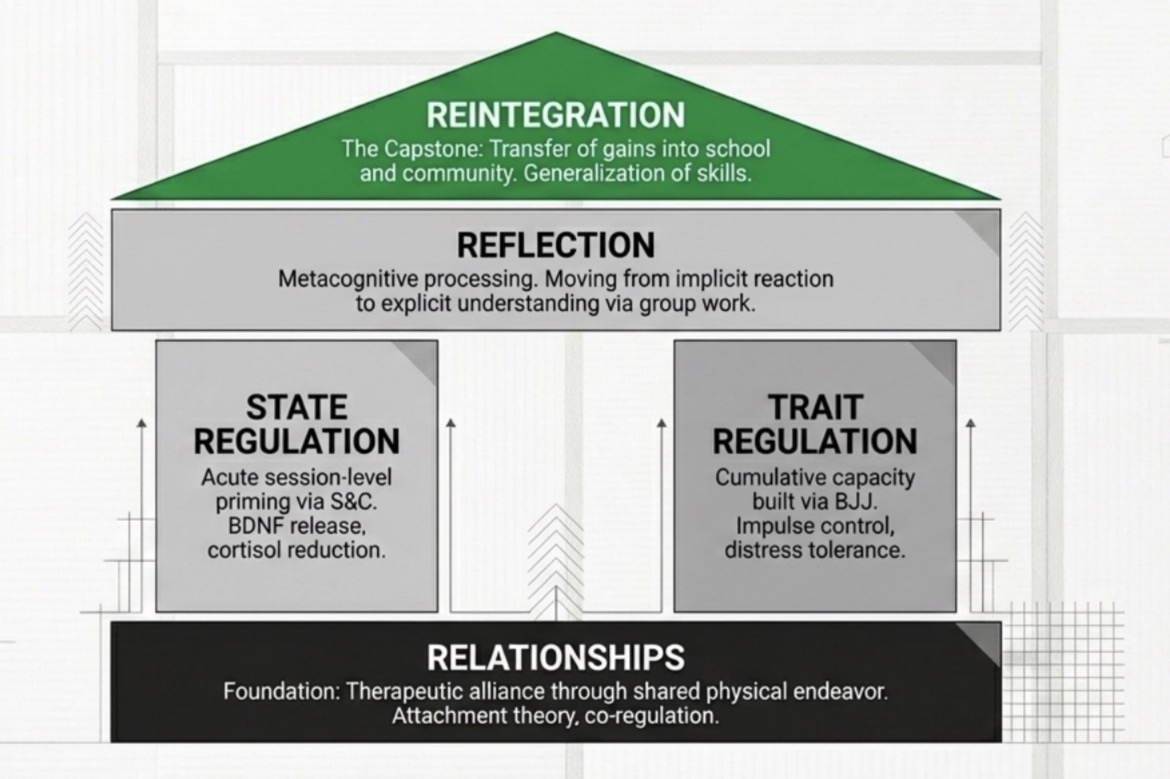
The programme is structured around four interlocking clinical mechanisms: Relationships (the foundation; without this nothing else functions), State Regulation (acute, session-level neurobiological priming for learning via S&C), Trait Regulation (cumulative emotional regulation capacity built through BJJ), Reflection (metacognitive processing in the group work block), and Reintegration (transfer of gains back into school and community). The three delivery blocks below serve these mechanisms in sequence.

Five Constructs framework: Relationships, State Regulation, Trait Regulation, Reflection, Reintegration
01
Block 1: 40 mins

Strength & Conditioning

Structured calisthenics and S&C as a neurobiological regulation protocol. Elevated heart rate yields BDNF release and cortisol reduction: opening the learning window before group work begins. Not warm-up. The clinical precondition for everything that follows.

02
Block 2: 40 mins

Therapeutic Group Work

Psychologist-facilitated sessions delivered into the regulated state. Psychoeducation, PSHE, ASDAN accreditation, community meeting. Young people move from implicit reaction to explicit understanding of their own responses. Grounded in Haigh's therapeutic community principles.

03
Block 3: 50 mins

Brazilian Jiu-Jitsu

No-gi, consent-based, trauma-informed BJJ. The tap is a structural consent mechanism and a daily practice in tolerating discomfort without explosive response. For a cohort whose default is fight-or-flight, learning to tap early is a measurable milestone in emotional regulation.

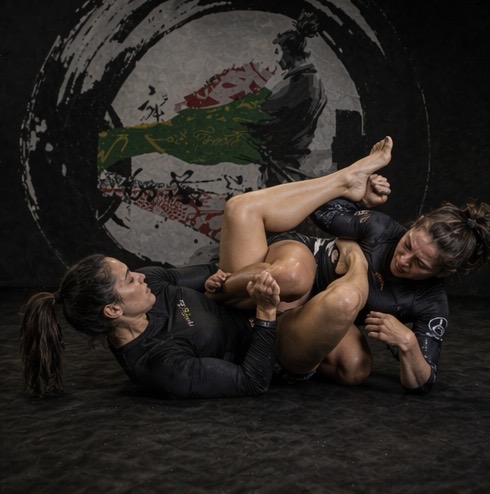
Post-session conversation on the mat Ground work drilling Programme Lead: Senior Forensic Psychologist, BJJ purple belt Female grapplers: ground work
Programme Culture

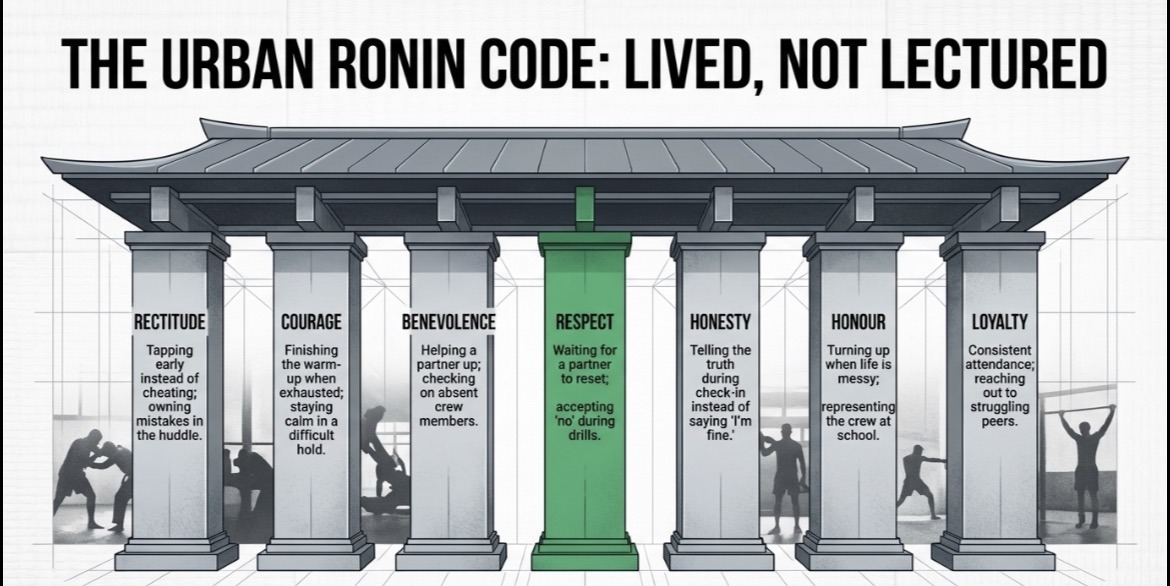
The Urban Ronin Code:
Lived, Not Lectured.

Identity and values are something most young people struggle with at this age. For young people at risk of exclusion the stakes are higher. The absence of a clear values framework leaves space for the wrong influences to fill it.

The Budo tradition frames virtue as something practised under pressure, not discussed in a classroom. That is why it works with this cohort. We take seven virtues from that tradition and adapt them for an urban community context; not as abstract ideals but as observable, nameable behaviours that staff call out live in session and young people record in their ASDAN portfolio work.

The seven virtues are: Rectitude (doing the right thing), Courage, Benevolence (do good by others), Respect, Honesty, Honour, and Loyalty.

They are not taught. They are lived: through every session, every drill, every interaction on and off the mat.

The Urban Ronin Code: seven virtues: Rectitude, Courage, Benevolence, Respect, Honesty, Honour, Loyalty
The Delivery Team

Clinical Governance
By Design.

Urban Ronin CIC is led by an HCPC-registered Senior Forensic Psychologist who holds the Designated Safeguarding Lead role. Where operationally and safeguarding requirements allow, staff participate across all three programme blocks. Shared physical endeavour (young people and staff together) is the primary trust-building mechanism, validated by trauma-informed physical activity research (Makawa, 2025) as a critical condition for building trust, modelling behaviour and doing by action, not just talk.

Clinical Lead & DSL
Programme Lead
HCPC-registered Senior Forensic Psychologist. BJJ purple belt. Peer-reviewed publications. Designated Safeguarding Lead. Architect of the Lost in the System Hypothesis.
Physical Lead
BJJ Head Coach
Brown belt. Delivers the teaching of techniques and concepts fundamental to Jiu-Jitsu, practised under guidance and tested via appropriate specific sparring. UKBJJA certified coach. → View Role
Physiological Lead
S&C Lead
Qualified personal trainer. Strength and conditioning specialist. Delivers the neurobiological regulation protocol that opens the learning window for every session. → View Role
Vacant: Recruiting
Psychosocial Youth Coach
This role supports the delivery of structured group work alongside the Psychology Lead, bringing psychological theory into the session in accessible, practical terms. The postholder participates across all three programme blocks and contributes to the relational culture of the programme. A background in psychology, youth work or a related field is essential. BJJ experience is desirable.
Board
Director & Safeguarding Lead Trustee
Mental health nursing background. Named Safeguarding Lead Trustee. Board oversight of governance, safeguarding, and organisational compliance.
Programme Structure

16 Weeks.
Four Phases.

11:00: Arrival
Check-In
Mood and readiness assessment. Safeguarding observation. DSL present.
11:20: Block 1
S&C
Brain chemistry activated. Stress hormones reduced. Learning window opens.
12:00: Lunch
Relational Time
All staff present. Facilitated informal social time. Therapeutic, not dead time.
13:00: Block 2
Group Work
Psychoeducation, PSHE, ASDAN portfolio, community meeting.
13:40: Block 3
BJJ
Progressive, consent-based no-gi drilling. Sparring card earned, not given.
14:30: Close
Check-Out
Session reflection. Virtue recognition from the Urban Ronin Code. Psychological check-out. DSL debrief.
Phase 1: Relationships
Epistemic trust building. Safety, belonging, and the relational foundation that makes every subsequent phase possible. No clinical mechanism activates without this.
Milestone: T0 baseline measures
Phase 2: Regulation
Routines, group norms and state regulation established. Basic BJJ positions. Neurobiological priming through S&C. No live contact until relationships are formed.
Phase 3: Reflection
Progressive skill building. Deepening psychoeducation. Positional BJJ work. ASDAN portfolio development. Young people begin naming and understanding their own regulation patterns.
Milestone: T8 midpoint measures
Phase 4: Reintegration
Consolidation. Supervised rolling where standards are met. Transition planning back into school and community. ASDAN Short Course completion. Graduation ceremony.
Milestone: T16 measures & Graduation
Evidence Base

Not Gut Feel.
Evidence-Informed.

BJJ & Regulation

Bueno et al. (2022) randomised trial demonstrates significant improvements in school behaviour and mental health in young males following a 12-week school-based BJJ programme, measured via teacher-report SDQ. Study conducted in Abu Dhabi secondary school (where BJJ is part of the school curriculum): findings are directionally consistent with the Urban Ronin model.

Exercise & Brain

Structured physical activity triggers the release of proteins in the brain that promote learning, memory and emotional regulation. This is the neurobiological mechanism that makes the group work and BJJ more effective: the body prepares the brain before the clinical work begins. Ratey (2008), Hillman et al. (2008), De Menezes-Junior et al. (2022).

Therapeutic Community

Haigh (2013) identifies five quintessences of therapeutic environments: attachment, containment, communication, inclusion and agency: each deliberately recreated in the Urban Ronin session structure.

Trauma-Informed Practice

Makawa (2025) and Darroch et al. (2020) establish TIPA principles for physical activity with trauma-affected populations. Urban Ronin's Physical Contact and Trauma Screening Protocol is built directly from this evidence base.

Identity & Desistance

Maruna (2001) on redemption scripts and McAdams (2001) on narrative identity establish the theoretical foundation. Walters (2020) confirms that internalising a delinquent identity actively impedes desistance. Klimukiene et al. (2026) find that identity diffusion predicts poor impulse control and emotional dysregulation above and beyond criminal history; making structured identity work a clinical priority, not an add-on. The Urban Ronin Code operationalises this through seven observable, nameable virtues recorded in ASDAN portfolio work.

Maruna, S. (2001). Making Good. APA Books. · McAdams, D.P. (2001). The psychology of life stories. Review of General Psychology, 5(2). · Walters, G.D. (2020). Desistance and identity. Criminal Justice Review, 45(3), 303–318. · Klimukiene, V. et al. (2026). Identity formation and dynamic risk factors. International Journal of Offender Therapy and Comparative Criminology.

Identity & Motivation

Ryan & Deci (2000) self-determination theory underpins the programme structure: autonomy (community meeting), competence (BJJ progression and sparring card), relatedness (crew and shared endeavour). Walpole (2024) validates the SportPlus boundary spanner coaching model that all Urban Ronin staff embody.

Outcome Measurement

Validated measures across three timepoints: SDQ self and teacher report (T0, T8, T16), WEMWBS (T0, T8, T16), GBO: participant self-defined goals (T0, T8, T16), and DERS-16 emotion regulation scale (T0 and T16 only: trait change is longitudinal). School attendance and exclusion records at baseline and endpoint. Session-level mood and readiness tracking every session. Exit interviews at T16. Pilot findings submitted for peer-reviewed academic publication.

Governance & Compliance

Built to
Standard.

Urban Ronin CIC is a registered Community Interest Company operating to statutory standards from day one.

Registered CIC: England & Wales
HCPC Registered Clinical Lead
Designated Safeguarding Lead
Safeguarding Policy v2.1: KCSIE 2025
Enhanced DBS: All Staff
UKBJJA Licensed Coaching
GDPR Compliant
EDI Policy v1.0
ASDAN Accreditation
Physical Contact Screening Protocol
Transfer of Violence Protocol
Safer Recruitment: KCSIE 2025
Funders & Partners

Back the Pilot.

Urban Ronin CIC is actively seeking grant funding to deliver the September 2026 pilot. If you represent a funder, school, or organisation aligned with our mission, we want to hear from you. We have documentation ready.

Contact Us Refer a Young Person Read the Hypothesis
Primary Funder Target
National Lottery Community Fund
Common Questions

Straight
Answers.

Who is this programme for?
Young people in Years 8–9 identified by school staff as at risk of exclusion, already excluded, or on a significantly reduced timetable. The pilot cohort starts at 10–12 participants at a Leicester secondary school, with sessions running September to December 2026. We expect attrition to 6–8: normal for this population and accounted for in our evaluation design. The project formally concludes February 2027 following data analysis and reporting.
Is this a martial arts club or an intervention programme?
An intervention programme that uses BJJ as one of three clinical mechanisms. The physical activity is not the goal: it is the neurobiological preparation mechanism that makes therapeutic and psychoeducational work possible. That distinction is what separates Urban Ronin from a sports provision.
How does it differ from existing alternative provision?
Most AP addresses behaviour through consequence or containment. Urban Ronin addresses the neurobiological and identity conditions that produce the behaviour. The Lost in the System Hypothesis is an original framework developed by a forensic psychologist specifically for this population and intervention window.
How are outcomes measured?
Four validated tools across three timepoints: SDQ (self and teacher report), WEMWBS, and GBO at T0, T8 and T16. DERS-16 at T0 and T16 only: trait change is longitudinal. School attendance and exclusion data at baseline and endpoint. Session-level mood and readiness tracking. Exit interviews at T16. All findings submitted for peer-reviewed academic publication.
What is the Urban Ronin Code?
The Urban Ronin Code is a seven-virtue framework drawn from the Budo martial arts tradition: Rectitude, Courage, Benevolence, Respect, Honesty, Honour, and Loyalty. Virtues are not taught abstractly; they are named live in session by staff and recorded in each participant's ASDAN portfolio work.
Is Urban Ronin CIC safeguarding-ready?
Yes. Safeguarding Policy v2.1 aligned to KCSIE 2025 and Working Together 2026. Enhanced DBS checks with Children's Barred List for all staff. Physical Contact and Trauma Screening Protocol and Transfer of Violence Prevention Protocol in place. A Senior Forensic Psychologist holds the DSL role.
How can we get involved?
Contact us at info@urbanronin.co.uk. We have a full documentation pack for funders and school partners: Theory of Change, Evaluation Framework, safeguarding policies, and budget breakdown. We are ready to present.